The Early Years
After the move from Watauga
County, Ransom grew to manhood in the Meadow Fork
community. This community was about 15 miles from
the settlement on Fines Creek, over in Haywood
County. The trip to Fines Creek took about all day
on foot or horseback. Going from Meadow Fork to
Fines Creek was not too bad, it was mostly all down
hill. However, the trip back was a different
story. It was a long uphill climb, often steep in
places.
It is not clear exactly how Ransom , the boy
from up in Watauga met the local Fines Creek girl,
Laura. There was a sizable age difference between
them. Ransom was 12 years old when Laura was born in
1878.
The years passed and Laura grew up. Like
all mountain children they had plenty of work to do
helping their families. Ransom often helped his
father, Harmon, in his logging work. After the
huge trees were cut down they had to be dragged or
snaked out to the sawmill to be cut into boards.
This was often done with teams of large oxen.
Ransom became an expert at handling and driving these
teams. Control of the oxen was by voice command
and the use of a bull whip. Evidently Ransom’s
skill and prowess with the whip became known through out
the community. Years later, far away in the
Pacolet community, old men who had worked with Ransom,
would still remember it. They said he could knock
a horsefly from an ox’s ear with that whip.
The Marriage
Sometime after 1890, Ransom must
have realized that Laura was no longer a little girl and
saw her in a different light. The story of their
courtship seems lost in the passing of time. But
court they did, for in about 1895, they were wed.
They were married in the town of Sevierville, Tennessee
about 70 miles from Fines Creek.
Tradition has it that Laura’s parents,
particularly James Russell, were not pleased. It
might have had something to do with the age
difference. In 1895, Ransom was 29 and Laura 17.
This “risky” marriage that bothered James would go on to
last for over 60 years. It would produce 11
children and more grandchildren, great grandchildren and
great great grandchildren than James Russell and his
wife Elizabeth could ever have imagined.
Ransom and Laura settled down in the Meadow Fork
community close to the homes of his father, Harmon, his
brother Samuel, and other family members.
Ransom and Laura farmed and Ransom still helped Harmon
with the logging and the sawmill. They started to
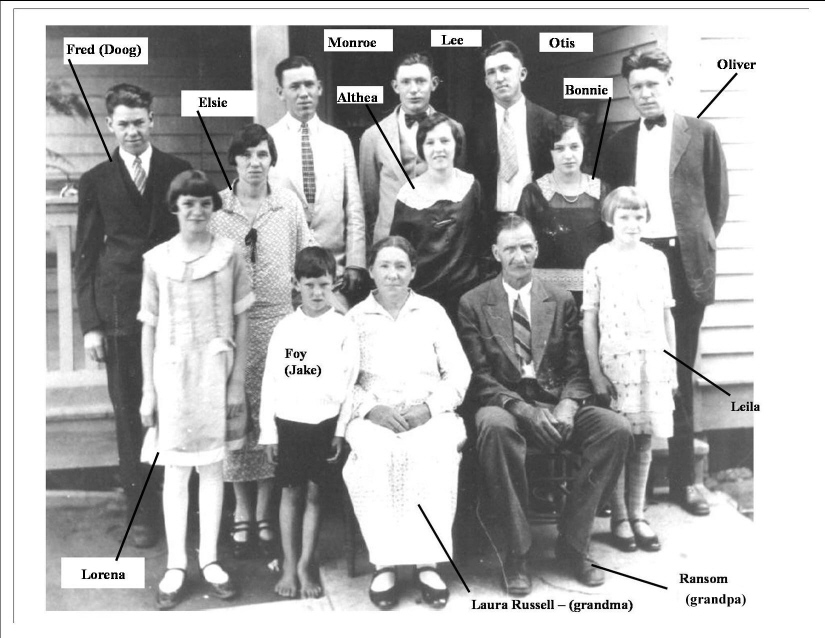
raise a family. Their first child, Mary Elsie, was
born the 23rd of February in 1896. The next child,
the first son, William Otis, was born September 30,
1898. Another son, James Oliver, was born on June
12, 1900. Still another son, Monroe, followed on
December 12, 1902. A fourth son, Lee (Bo), arrived
on January 3, 1905. In all, they had five children
while they still lived in the mountains of North
Carolina. Ransom and Laura would go on to have a
new child about every two years until the last child Foy
(Jake) was born on June 27, 1920. All the rest of
the children would be born in South Carolina. They
would have a total of eleven children. All of them
lived to see adulthood at a time when many, many
children died.
Changing Times
In the fall of 1905, a tragedy
stuck the close knit families and communities of Meadow
Fork and Fines Creek. Harmon was killed in a
sawmill accident . Harmon left his widow, Susie,
but his children were all grown by this time.
Harmon’s death must have been a terrible blow to the
family members.
The next year there was another loss when Susie,
Harmon’s widow, died. Ransom and his brothers and
sisters had lost both parents in a period of less than
two years.
Life in the mountains was hard. It required the
endless labor of all the family members to make a
living. Life was particularly hard on
children. There was almost no medical care of any
kind back in the mountains. The simplest childhood
disease could take the life of a child. A little scratch
could become infected, turn into blood poisoning and
death could result. Home treatments could
sometimes help cure a disease but often these were more
like superstitious rituals.
The Meadow Fork and Fines Creek regions were wild and
remote even for the turn of the 20th century. Travel was
on foot or by wagon or on horseback over steep and
rugged country. It was a trip of a full day to the
Haywood county seat of Waynesville, if the weather was
favorable.
These wild conditions took their toll on children,
too. One of Ransoms’s relatives, a little girl,
died of snake bite. She had leaned over to get a
drink from a spring. A copperhead snake struck her
on the cheek. She had run home with the snake
still hanging from her face by its fangs.
There was little opportunity for an education for many
mountain children. There were few schools back in
the mountains. Even if there were, most children’s
help was needed with running the farm, carrying water,
chopping wood and a thousand other things. Ransom
would later tell some of his grandchildren that he had
never been to school. One of the most
knowledgeable and wise men in the world, to these same
grandchildren, could not write. He read the
newspaper with a slow, deliberate effort moving
his lips silently to pronounce each word. (After a
period of over 50 years since I saw him do this it
still brings a lump to my throat to think about it and
how difficult it must have been for him.)
Promises of a Better Time
Stories had been spreading through
the mountain communities for some time that a
better life was available far off in the Piedmont
area of the Carolinas and Georgia. It was said
that there were many jobs there just for the
asking. The jobs paid hard cash and everybody
could work, even the children. There was even
more, if a family took a job, they got to live in a
house as part of it. There were said to be lots of
these houses and they had coal stoves and fireplaces in
every room. There were stores to buy things for
the people in the houses. There were also free
schools with free books for all the children who wanted
to attend.
The basis for these stories was true. They were
describing the opportunities that existed in the textile
towns and mills that developed all over the upper parts
of the Carolinas and Georgia. They had started in
a small way as a means to recover the South’s economy
after the Civil War. They had been successful and
northern textile industrialists had joined in. By
1900 the textile industry was booming and beginning to
have a difficult time finding enough labor to operate
the mills. The textile plants and the mountain
people discovered each other. Movement of the
mountain folks down to the lower areas started as a
trickle and then became a flood.
It is not sure how Ransom and Laura got word about the
jobs in the cotton mills. The mills sent
recruiters up through the mountains to inform the people
about the opportunities and to sign them up for
employment. Maybe they talked to one of these
recruiters. Maybe they heard from one of the local
families that had gone on before them.
According to family tradition,
Ransom and Laura were preparing to leave the Meadow Fork
and Fines Creek areas for another place before they
decided to come to South Carolina to the textile
mills. They were going to Arkansas to
settle. But, according to the family story,
Grandma Laura’s parents were strongly against the move
because it was too far away. It is not clear why
they had chosen Arkansas. One of Grandpa Ransom’s
brothers, Jethro, eventually moved with his family to
Arkansas but was not there at that time. Today,
there are a number of Teaster families in Arkansas that
are related to us. Perhaps, Ransom and Laura knew
Teaster relations out there and planned to join them.
Leaving Home
What is known, is that about 1907,
Ransom and Laura made up their mind and decided to make
the move to South Carolina. It is likely that
Ransom’s emotional ties to his childhood mountain
home had slackened with the death of both of his parents
within the last two years. Laura’s parents were
still there along with brothers, sisters, aunts, uncles,
nieces and nephews on both sides. It must have been an
emotional parting for everybody.
The family story is that the destination they chose was
Clifton Mills in Spartanburg County, South
Carolina.Clifton was located on the Pacolet River about
100 miles from Fines Creek and it was going to be a long
trip. The story told is that Ransom and Laura
loaded all their belongings and their five small
children into wagons and made the slow 15 mile trip to
the railroad station at Waynesville or Clyde. The
train took them another 90 miles or so to the
Spartanburg area. Wagons took them from the
station to the town of Clifton.
Not much is known or remembered about living or working
in Clifton. It does seem that Bonnie Mae was born
there on September 14, 1907. She was the first
child born in South Carolina. The experience of
Clifton must have been a serious shock for all of
them. In a period of about one week, they had left
their mountain home with its open area and incredible
views and been transported to live in the middle of more
people than they had ever seen. The homes on the
mill village in Clifton were well built against the
weather but they were so close together. The
houses went on, side by side, on both sides of the
street for what seemed to be miles.
It must have been a tremendous change for Ransom.
He went from working almost completely outside as a
farmer and logger to an inside existence. Where
once he had worked almost for himself, now he had to
take orders from someone he did not know. His
every move was watched and controlled. Inside the
mill was a vastly different place than he had ever
known. It was a huge, cavernous place. The
noise was unbelievable. It was louder than any saw
mill or corn mill in the mountains. The air was
filled with cotton dust. There were huge clanking
machines with parts flying around and back and
forth. An unwary worker could be caught and pulled
into these machines as easily as they moved the thread
and cloth. Ransom and the other workers were in
the mill at their job from daylight till dark- twelve
hours a day, six days a week.
Still, there were many good things
about living in the mill village. There was a
school for the children who did not work. However,
many children did work in the mill, some starting as
young as six years old. Ransom and the other
workers were usually paid with actual cash. Cash
money had been very scarce back in the mountains.
Sometimes workers could be paid with company script
instead of cash. This script could be spent, just
like money, in the company store that was owned and
operated by the owners of the mill company. The
company store usually had a variety of groceries, shoes
and other items. The store had more things to buy
than some of the mountain children knew existed.
Most mills allowed their workers to charge items on
credit at the company store. This was charged
against their next paycheck at the mill. Unless a
family was careful, they could get into almost perpetual
debt at the store. Instead of getting money on
payday, they would see it credited to what they already
owed at the store. Most mill villages had either a
doctor or nurse and a medical clinic to treat the sick
and to help deliver new babies.
A New Life
Ransom and Laura’s reaction to
life in the mill village must not have been very good at
Clifton. Sometime in the next year, 1908, they
left the jobs at Clifton and moved back to the Fines
Creek vicinity. However, they only lived in Fines
Creek for a short period of time .By the time their next
child, Fred (Doog) was born on April 28, 1910 they had
moved back to South Carolina for good. Ransom and
Laura and their increasing family lived and worked at
several mill communities including Monarch mills, and
maybe others, in Union County. Althea was born on
November 24, 1912 , Agnes Lorena on November 14,
1914 and Leila on January 3, 1918. The last child
Foy (Jake) was born on June 27, 1920. Sometime in
the 1920’s or 1930’s they more or less settled
down in the Pacolet Mills
area.
In the years between 1896 and 1920, a period of 24
years, Grandma Laura had eleven children. This
means that she was pregnant for a total of over 8
years. During this time, she moved her household
and children back and forth from the mountains to South
Carolina twice and made several shorter moves. In
doing all this she had to take care of all the children
and do most of the housework. This housework
included cooking on a wood stove, churning and making
butter and canning. In addition, she probably had to do
a major part of the milking, gardening, killing and
dressing chickens and much more. Her relief from
all this work was to take time out to have another
child. She is remembered fondly as a short, very
tough lady. In looking back, I remember, maybe
wrongly, that Mamma Teaster’s word was the law. It
seemed, from a child’s view, that Papa Teaster and all
her grown male children were quick to heed her
directions. Present and future generations of the
family, when faced with what they think is a hard or
difficult life, might reflect on Grandma Laura Russell
Teaster and what she accomplished. She taught us
all that a small stature can hide a huge heart and
strength.
For a time, Ransom and Laura and the family farmed on a
sharecropper basis in Cherokee County in the Blue Branch
area. Ransom and some of the children also worked in the
mill during that time.
This must have been about the time
of World War I and the great, world wide influenza
epidemic. Thousands of people, including entire
families, were killed by this disease all over the
country. It was very bad in parts of the
South. Family stories say that Ransom had an
unusual approach to preventing the disease. The
disease was worst in the winter when everyone was shut
up in their houses. It is said that Ransom thought
that fresh air was the best prevention to the flu. He
kept the windows and doors open even in the coldest
weather during the epidemic. Drastic as it seems,
it worked. No one in the family died of the flu
but many people in the area did.
Sometime during this period Ransom and Laura took in
another child to raise. His name was Andy
Suttles. The details of how Andy came to live with
Ransom and Laura are not clear. However, he evidently
became a member of the family and lived with them until
he was an adult.
Family Gatherings
Throughout the 1940’s the house in
the country was the place for many family
gatherings. Some of the largest of these
were the “Birthday Dinners” held for Ransom and
Laura. Almost all of their children, grandchildren
and many friends would come. Usually they were
held on Sunday afternoons. Every family brought
food. All this food would be set up on tables in
the backyard. Everyone would pass by and fill their
plate. It was a feast. There seemed to be
every kind of meat and vegetable and an enormous number
of different kinds of pies, cakes and other desserts.
There was no organized, formal program for the
dinners. The adults mostly ate and talked and got
caught up on the family gossip. The many
grandchildren ate, ran around, made noise and just had a
good time. Sometimes, something would happen that
would draw the adults away from the talk and the
food. At one dinner, one of the uncles brought his
.22 rifle. An impromptu shooting range was set up
with a board nailed to a tree at a considerable distance
off in the woods. The men took turns shooting at
small objects fastened to the board. They started
off by shooting at a small piece of cardboard about the
size of a business card. Well, that did not seem
to be a worthy target since all of them hit it.
From there they went to a smaller target and then still
smaller. I remember that the target was so small
that I could not even see what it was. But some of the
uncles and older cousins were still hitting it.
The unusual lesson that came out of this for one little
boy was that you had better learn to shoot if you want
to be an adult in this family.
At other times, some of the men would harness up a
horse or mule to ride in the lot beside the barn.
I still have a vivid memory of riding one of these with
a cousin and both of us falling off into blackberry
vines alongside the fence.
Mostly though, the gatherings were
a time for family members to meet and talk. There
were always stories about the “olden times” when the
children were growing up. Most of them were very
funny and the aunts and uncles vied with each other in
telling stories.
Most of the grandchildren took all of this in.
It was at these kinds of family gatherings that it began
to be clear that Laura and Ransom, their children and
grandchildren had a special kind of bond. They had
a caring and compassion for each other that showed at
these events.
The End of the Story
Grandpa and Grandma Teaster lived
in the house in the country until about 1948 or
1949. Then age and health began to take its
toll. In 1948, Grandpa was 82 years old and
Grandma was 70. To the great dismay of everybody,
Ransom’s once keen mind began to go. He became
confused and had trouble sorting out reality and
illusion. His physical health was strong while his
mental health slipped away.
It was no longer possible for Grandpa and Grandma to
stay by themselves. They each went to stay with
different children. The household was broken up,
livestock disposed of and the magic kingdom of “Down in
the Country” was no more.
Grandpa only lived a few years after this. In
the last years he was only a shell of the man we had
known. The Papa Teaster that all of us
grandchildren had loved disappeared in the mist of old
age. On August 25, 1953, this kindly,
compassionate man died. He was 86 years old.
Grandma’s mind was clear but her physical health
deteriorated. She outlived Grandpa by 15 years and
died on Christmas Day in 1968. She was 90 years
old.
With their passing, the first
part of Ransom and Laura’s story came to an end.
But it was not really an end. It goes on in each
one of us and our children and grandchildren and great
grandchildren. Let us hope that the memory of
Laura and Ransom and their troubles and triumphs will
pass down through the family and give comfort and
encouragement to generations yet unborn.
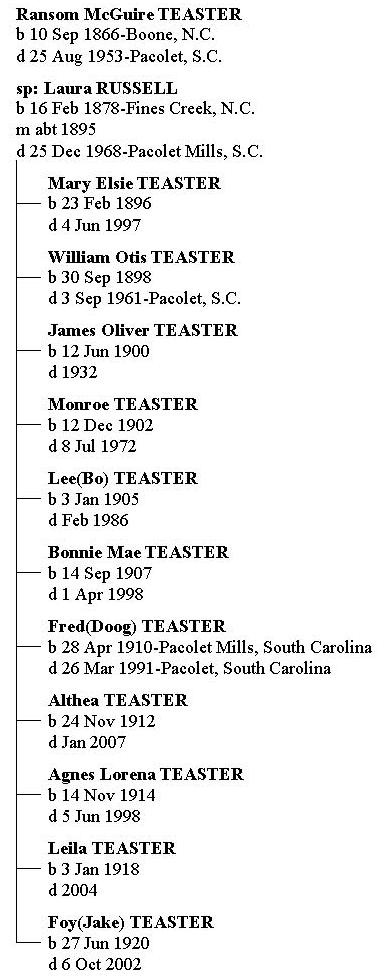 The Family of Ransom and Laura Teaster
More details about the Teaster family can be seen at
https://teastermckinney.com/
.